
Blog
Rolling Forecasts for 1Million–10 Million Businesses: A Practical Guide to Better Financial Decisions
A profitable business can still struggle to make payroll two weeks later.
A large customer pays late. Inventory has to be paid for before the related sales are collected. A new employee starts before the revenue from that hire comes in.
These problems may not show up in your sales goals or projected profit. They become obvious when you map out when money is expected to come in and when it needs to go out.
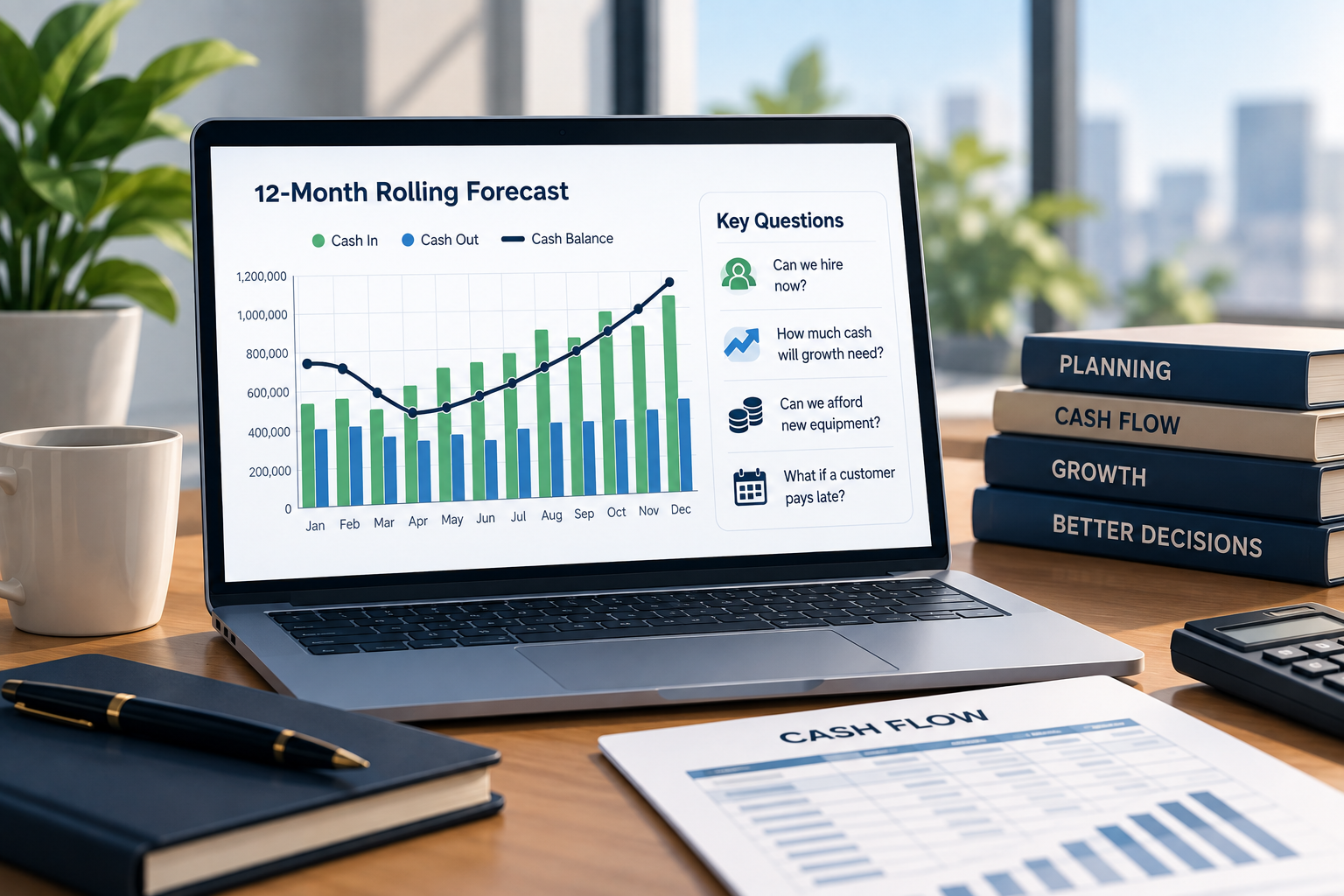
That is what a rolling forecast is for. It shows you what you expect to come in, what you expect to go out, and when.
What a Rolling Forecast Actually Does
A rolling forecast is not just a 12-month budget that gets updated once in a while.
It is a current view of where the business is headed based on what you know today.
If sales change, a customer pays slower than expected, or you decide to hire, buy equipment, or take on more inventory, the forecast changes with it.
That matters because business decisions rarely happen one at a time.
Sales growth, for example, can mean more inventory, more employees, higher payroll, more receivables, and more cash tied up before customers pay you.
A rolling forecast helps you see those effects before you commit to the spending.
The same applies when sales slow down. You can see how long your current cash can support the business, what payments are coming up, and where you may need to make adjustments.
For an owner, the forecast should help answer practical questions:
- If we hire now, when can the business comfortably absorb the added payroll?
- If sales grow 20%, how much additional cash will we need?
- If a major customer pays late, how much cash do we need to cover the gap?
- How much can we spend on equipment without putting pressure on payroll, taxes, or debt payments?
- If sales fall for the next three months, how much cash do we have to work with?
- If margins are lower than expected, what does that do to profit and cash?
The point is not to predict the future perfectly. It is to understand what the business can support based on what you know today.
How to Build a Rolling Forecast
You do not need a complicated model. You need a reasonable starting point, realistic assumptions, and enough detail to see what matters.
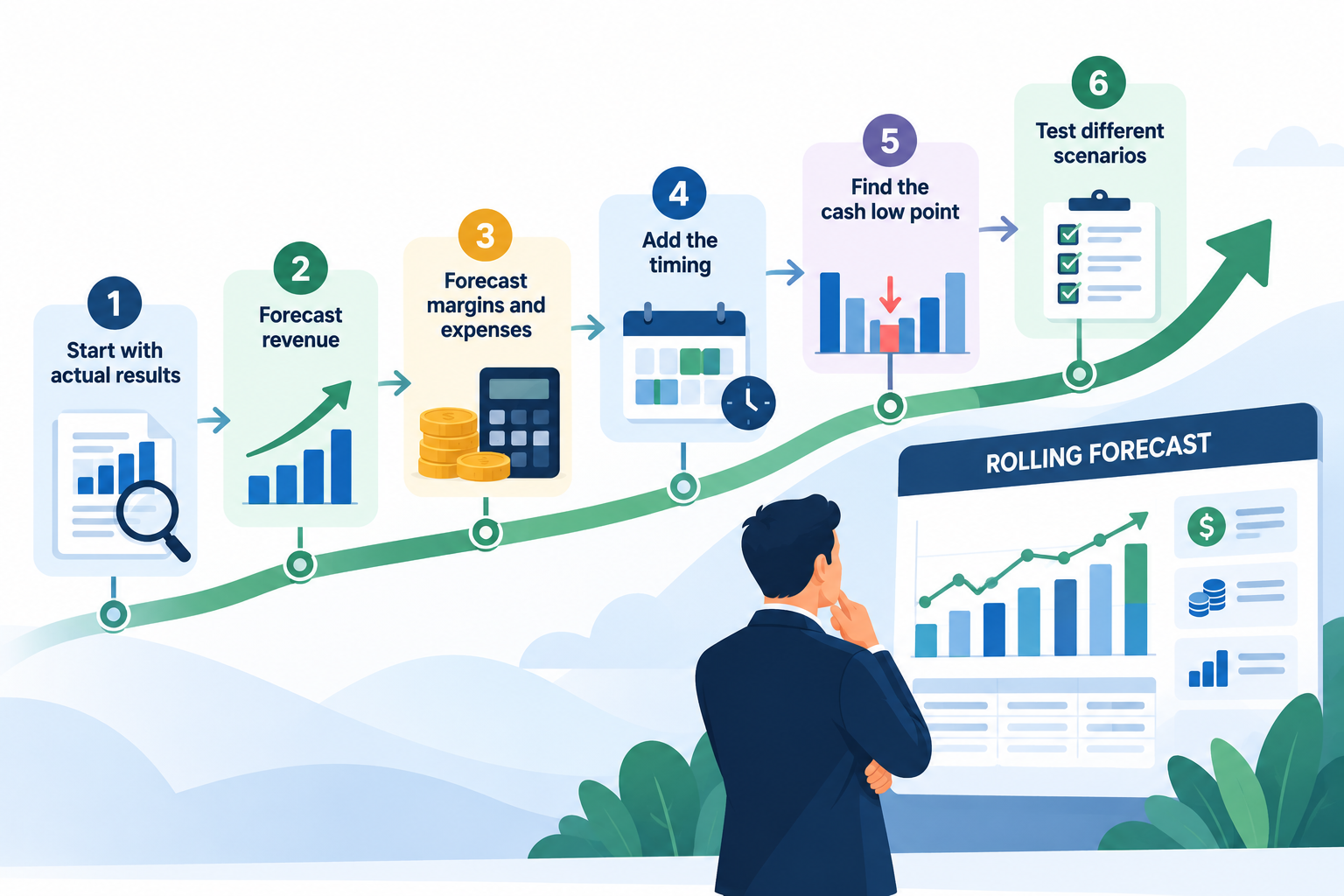
1. Start with actual results
Start with where the business stands today: cash, receivables, payables, inventory, debt, sales, and expenses.
Do not simply take last year's numbers and add a growth percentage. If the starting numbers are wrong, the forecast will be wrong too.
2. Forecast revenue based on what you actually know
Look at signed contracts, existing customers, expected orders, project start dates, sales pipeline, seasonality, and available capacity, depending on the business.
Keep committed revenue separate from opportunities that have not closed.
If a planned hire depends on winning a contract that has not been signed, that should be clear in the forecast.
3. Forecast gross margin and operating expenses
More revenue does not automatically mean more profit.
Consider the costs that come with the work: materials, direct labor, subcontractors, freight, and other costs that rise with sales.
Then add the major operating expenses and any changes you already know are coming, such as hiring, equipment, rent, marketing, or other significant commitments.
4. Put the timing into the forecast
This is where a forecast becomes more useful than a simple profit projection.
Revenue is not the same as cash collected. A customer may take 30, 60, or 90 days to pay, while suppliers may need to be paid much sooner.
Map out when cash is expected to come in and when it needs to go out.
Include major cash items such as taxes, debt payments, equipment purchases, and owner distributions.
5. Look at the cash low point
Do not just look at year-end cash.
Look at the lowest projected cash balance and when it occurs.
You may have a profitable year and still have a cash shortage in May. Knowing that in February gives you time to decide what to do.
6. Test the forecast
Look at what happens if something important changes.
What if a major customer pays a month late? What if a project starts six weeks later? What if sales are lower than expected or gross margin falls?
You are not trying to predict the worst case. You are trying to understand how much room the business has if things do not go as planned.
How to Keep It Useful
A forecast is only useful if you keep it current.
At least once a month, compare what you expected with what actually happened.
Did sales come in as expected? Did customers pay when expected? Were expenses higher or lower than planned?
Then update the months ahead based on what you know now.
Do not change every number simply because one month was different. First understand why.
A delayed customer order is different from a lost customer. A one-time repair is different from a permanent increase in expenses. A late payment is different from a change in how customers normally pay.
The forecast should change when the business changes.
Over time, the forecast should get better because you are learning how the business actually behaves—not because the spreadsheet is becoming more complicated.
Turn Each Update Into an Action
Updating the numbers is only half the job. The real value comes from understanding what changed and deciding whether anything needs to change because of it.
A monthly review can focus on four questions:
- What changed from our last forecast?
- When will our cash be at its lowest point?
- What could throw off the forecast?
- Is there a decision we need to make now?
For example, the forecast may show a profitable year but also show that cash could get tight in May.
That is not necessarily a profit problem. It is a timing problem.
You may need to collect an overdue account, invoice completed work sooner, delay an inventory purchase, postpone a large expense, or make other arrangements before May gets here.
The forecast gives you time to see the problem and decide how to handle it.
That is the real value of a rolling forecast: keeping the financial picture current enough that you can see what is changing, understand what it means, and make decisions while you still have options.
Arnold CPA can help you build and maintain a forecast that connects your financial numbers to the decisions you need to make as a business owner.
The goal is to help you see potential cash gaps, plan ahead, and make financial decisions before you run out of options.
👉 Schedule a consultation: tdacpa.com/appointment

.jpg)


Arnold CPA is a licensed
accounting firm in Houston, Texas.
providing tax, accounting,
and CFO services for small businesses.
License no. C10791
| ACCOUNTING | TAX SERVICES | BUSINESS ADVISORY |