
Blog

Stop the Cash Flow Chaos
Your business is profitable, but you’re still worried about cash. Where is the money going?
Why Profit Doesn't Always Mean Cash
I was talking with Sarah, who runs a $6 million service business. She's sharp, has a loyal client base, and knows her industry inside and out.
Yet every month, she faced the same problem.
Some weeks, the bank account looked healthy. Other weeks, she was scrambling to cover payroll or vendor invoices.
The business was profitable. The problem was that Sarah could not reliably predict when cash would come in or when it would go out.
I've seen this many times with growing businesses. The owner is excellent at running the company, but cash management is still based on experience, memory, and reacting to whatever is happening that week.
That can work for a while.
Then the company grows.
More customers mean more receivables. More employees mean more payroll. More vendors mean more obligations. Larger projects can create bigger gaps between paying expenses and collecting revenue.
At that point, the way you managed cash at $1 million in revenue may not work at $5 million or $10 million.
Growth doesn't just increase revenue. It increases financial complexity.
Think of Your Cash as a Bucket
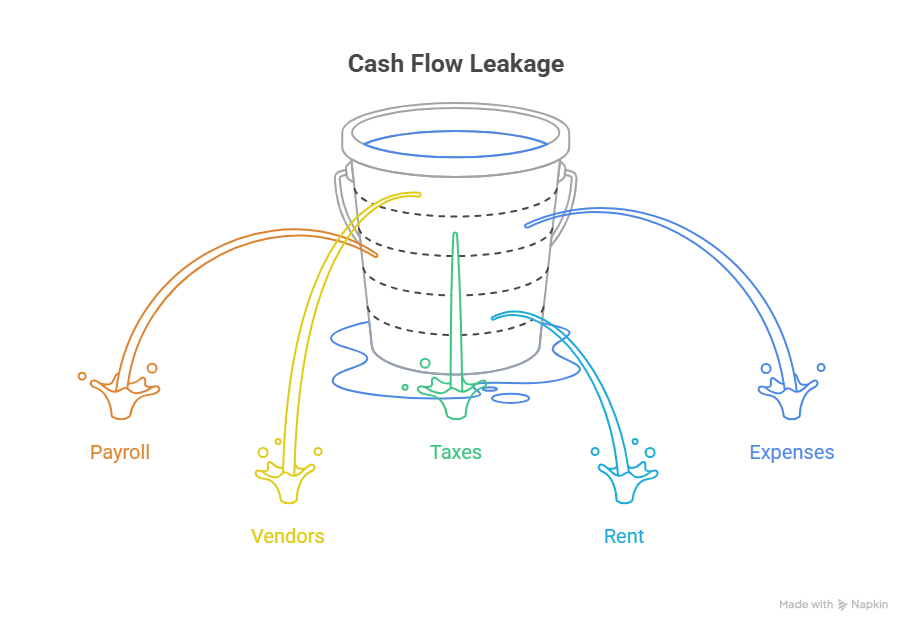
I like to think of business cash as a bucket of water.
Money comes into the bucket through customer payments, deposits, collections, and other sources of cash.
Money leaves through payroll, vendor payments, taxes, rent, debt payments, equipment purchases, and other expenses.
The objective is not simply to keep filling the bucket.
You need to know how fast the water is coming in, how fast it is going out, and where the holes are.
Those holes are often easy to overlook:
- Invoices are sent late.
- Customers take longer to pay.
- Employees are unclear about who follows up on overdue invoices.
- Payroll comes due before large customer payments arrive.
- Vendor payments are made without considering upcoming cash needs.
- Unexpected expenses consume temporary cash surpluses.
- Profitable projects tie up cash for months.
None of these problems necessarily means the business is failing.
But together, they can create constant cash-flow pressure.
When Experience Stops Being Enough
Sarah knew her business well.
She knew which customers usually paid on time. She knew which vendors would give her extra time. She knew which projects were profitable.
For years, that knowledge was enough.
But as the company grew, too many moving pieces were involved for Sarah to keep managing everything herself.
Employees didn't always know who was responsible for following up on overdue invoices.
Payments sometimes went unnoticed until they became urgent.
When the company had extra cash, Sarah couldn't confidently determine how much she could safely spend because she didn't have a clear view of what was coming next.
This is a common growth trap.
The first stage of managing cash is often driven by experience and effort. The next stage requires systems.
That doesn't mean the CEO has to become a financial expert.
It means the business needs a process that doesn't depend on the CEO remembering everything.
How Do You Build a Predictable Cash-Flow System?
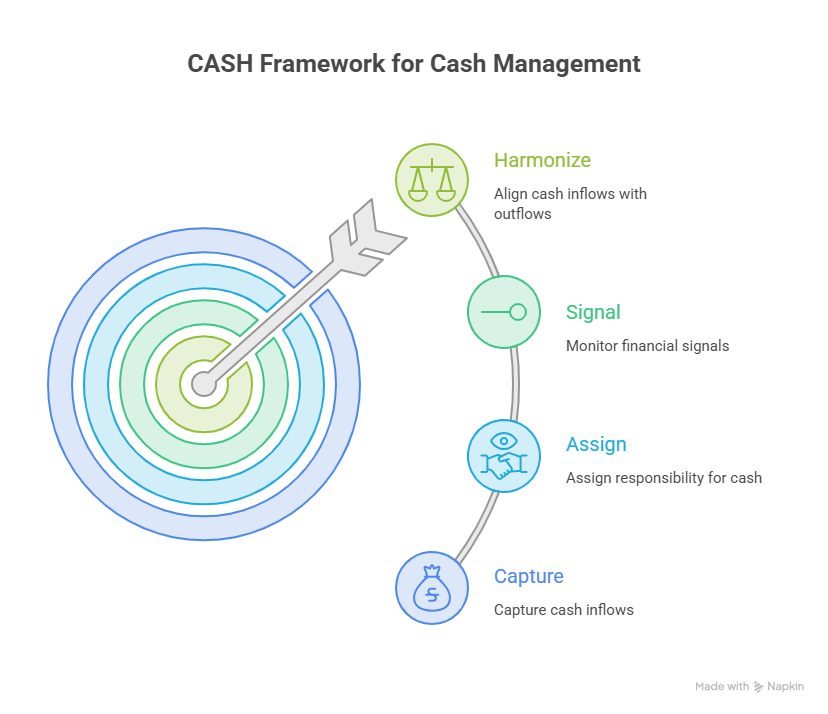
Start by knowing what is happening, assigning responsibility, watching the right signals, and coordinating the timing of cash coming in and going out.
This is the thinking behind the CASH framework I use:
C: Capture
Capture means mapping your cash inflows and outflows so you know where the money is coming from and where it is going.
Start with the basics:
- Customer collections
- Deposits
- Payroll
- Vendor payments
- Taxes
- Debt payments
- Rent
- Equipment purchases
- Other major cash commitments
If you don't have a clear picture of your cash movements, you can't manage them effectively.
A: Assign
Assign means giving someone clear ownership of each cash-related process.
Who sends the invoices?
Who reviews accounts receivable?
Who follows up with customers who are late?
Who approves vendor payments?
Who reviews the cash forecast?
When ownership is unclear, small problems become expensive problems.
A good system should not require the CEO to constantly ask, "Did someone take care of that?"
S: Signal
Signal means tracking the financial metrics that tell you where your cash flow is heading.
For example:
DSO, or Days Sales Outstanding, shows how long customers take to pay.
If your DSO is increasing, sales may be growing while cash is getting tied up in accounts receivable.
DPO, or Days Payable Outstanding, shows how quickly you are paying vendors.
Cash runway helps you understand how long your available cash can support the business based on expected cash needs.
Project or job profitability shows whether the work generating revenue is actually producing an acceptable margin.
These numbers are signals.
They give you time to act before a cash problem becomes an emergency.
H: Harmonize
Harmonize means aligning the timing of cash coming in with the timing of cash going out.
This is where cash forecasting becomes important.
Imagine your customers typically pay in 45 days, but payroll is due every two weeks and your vendors expect payment within 15 days.
You can be profitable and still have a cash shortage.
The answer may involve improving collections, changing billing schedules, negotiating payment terms, requiring deposits, adjusting purchasing decisions, or simply knowing when the cash gap will occur.
The goal is to make the bucket predictable.
What Changed for Sarah?
Once we applied this thinking to Sarah's business, the focus shifted from reacting to the bank balance to managing the future cash position.
Invoices were issued promptly and followed up consistently.
Payroll and vendor payments were scheduled with upcoming collections in mind.
The company began reviewing cash projections weekly and looking ahead 30 to 60 days.
Each important cash process had an owner.
Sarah no longer had to rely entirely on memory to know what was happening.
The biggest change wasn't a complicated piece of software.
It was visibility.
She could see what cash was coming in, what was going out, and where potential problems were developing.
That gave her the ability to make decisions earlier.
Instead of asking, "Can we afford this?"
She could ask:
"What will our cash position look like after we make this investment?"
That's a much better management question.
Why Do CEOs Struggle With Cash Flow?
It's usually not because they're careless.
CEOs are focused on customers, employees, sales, operations, and growth. That's where their attention should be.
The problem is that financial systems often don't grow at the same pace as the business.
A bookkeeper may be recording transactions accurately, but accurate bookkeeping alone doesn't tell you what your cash position will look like 60 days from now.
Financial statements tell you what happened.
A cash forecast helps you understand what may happen next.
For a growing business, you need both.
What Should a $1M to $20M Business Owner Be Watching?
You don't need a complicated dashboard with 50 metrics.
You need a few numbers that actually help you make decisions.
At a minimum, I would want to see:
- Cash balance
- Accounts receivable
- Accounts payable
- DSO
- DPO
- Gross margin
- Net profit
- Project or job profitability
- Upcoming tax payments
- Debt payments
- Rolling cash forecast
The exact metrics will depend on the business.
A construction company may need detailed job-costing and billing analysis.
A manufacturer may need to focus heavily on inventory and working capital.
A service company may have fewer inventory issues but much more exposure to accounts receivable and payroll timing.
Your cash-flow system should match the way your business actually operates.
The Biggest Cash-Flow Mistake I See
The biggest mistake is managing cash based on today's bank balance instead of the company's future cash position.
If you have $500,000 in the bank today, that doesn't necessarily mean you have $500,000 available to spend.
You may have payroll coming due.
You may owe vendors.
Taxes may be due next month.
A customer may delay a $200,000 payment.
You may have equipment or other investments planned.
The bank balance is a snapshot.
The cash forecast tells the story.
That is why I believe growing businesses should maintain a rolling cash forecast and review it regularly.
Stop Managing Cash by Intuition
Sarah's problem wasn't that she didn't understand her business.
She understood it extremely well.
Her problem was that the financial system hadn't kept up with the business.
That's an important distinction.
As your company grows, you should not have to become the person who knows every invoice, payment, vendor, and upcoming obligation.
You need a system that gives you visibility without requiring you to manage every detail yourself.
That's the role of good financial management.
At Arnold CPA, I look at cash flow from both the CPA and CFO perspective. The goal isn't simply to produce financial statements after the month is over.
The goal is to give the CEO useful information while there is still time to make a decision.
Key Takeaway
Cash-flow problems are often a systems problem, not a sales problem.
As your business grows, replace intuition with clear processes, ownership, financial signals, and a rolling cash forecast.
Find the leaks. Fix the system. Predict the cash. Then use that visibility to grow.
FAQs
Why can a profitable business still have cash flow problems?
A profitable business can still have cash flow problems because profit does not show the timing of customer collections, payroll, vendor payments, taxes, debt payments, and other cash movements.
What is a cash-flow forecast?
A cash-flow forecast projects expected cash inflows and outflows over a future period so a business can identify potential cash shortages or surpluses before they happen.
What is DSO?
Days Sales Outstanding, or DSO, measures how long it takes a business to collect payment from customers after a sale.
What is DPO?
Days Payable Outstanding, or DPO, measures how long a business takes to pay its suppliers and vendors.
How often should a business review its cash forecast?
A growing or financially complex business should generally maintain a rolling cash forecast and review it regularly, often weekly when cash visibility is critical.
What is the CASH framework?
The CASH framework stands for Capture, Assign, Signal, and Harmonize. It provides a practical way to understand cash movements, assign responsibility, monitor financial signals, and align cash inflows with outflows.
What is the biggest cash-flow mistake CEOs make?
The biggest mistake is managing cash based on today's bank balance instead of forecasting future cash inflows, outflows, and obligations.
How can a CEO improve cash-flow predictability?
A CEO can improve cash-flow predictability by improving collections, assigning ownership of cash processes, monitoring key financial metrics, and maintaining a rolling cash forecast.

.jpg)


Arnold CPA is a licensed
accounting firm in Houston, Texas.
providing tax, accounting,
and CFO services for small businesses.
License no. C10791
| ACCOUNTING | TAX SERVICES | BUSINESS ADVISORY |