
Blog

7 Form 5472 Mistakes That Can Cost a Foreign-Owned US Business $25,000
Form 5472 is a federal information return.
A foreign-owned US corporation, including certain foreign-owned US disregarded entities, may have to file Form 5472 when it has reportable transactions with a related party.
The penalty for failing to file Form 5472 when required is generally $25,000. The same penalty can apply when the form is filed in an improper manner, when it is substantially incomplete, or when required records are not maintained. If the failure continues for more than 90 days after IRS notice, an additional $25,000 penalty can apply for each 30-day period, or part of a 30-day period, that the failure continues.
The important point is this:
A foreign-owned US business can have a Form 5472 filing requirement even when it has little or no income and no federal income tax due.
Here are seven common mistakes.
1. Assuming a Single-Member LLC Does Not Have to File
A foreign-owned single-member US LLC may be disregarded for federal income tax purposes.
That does not automatically eliminate Form 5472 reporting.
A domestic disregarded entity that is wholly owned by a foreign person is treated as a reporting corporation for certain Section 6038A reporting requirements. If it has reportable transactions, it may need to file Form 5472 with a pro forma Form 1120.
A common assumption is:
"The LLC is disregarded and had no revenue, so there is no federal filing."
That can be wrong.
For example, a foreign owner may:
- Put money into the US LLC
- Pay a US expense directly
- Receive money from the LLC
- Loan money to the LLC
- Repay a loan
- Pay an expense on behalf of the LLC
Some of these transactions may create Form 5472 reporting requirements.
Example
A non-US individual owns a US single-member LLC and transfers $20,000 to the LLC's bank account to fund startup costs.
The LLC has no sales during the year.
The funding transaction may still need to be reported.
The IRS specifically treats a foreign-owned US disregarded entity as a reporting corporation for Section 6038A purposes.
2. Ignoring Contributions, Distributions, and Formation Activity
Foreign-owned US disregarded entities have additional reporting requirements for certain transactions involving the entity itself.
Part V of Form 5472 covers certain transactions involving:
- Formation of the entity
- Dissolution of the entity
- Acquisition or disposition of the entity
- Contributions to the entity
- Distributions from the entity
These transactions are described in an attached statement.
This can create a problem for newly formed LLCs.
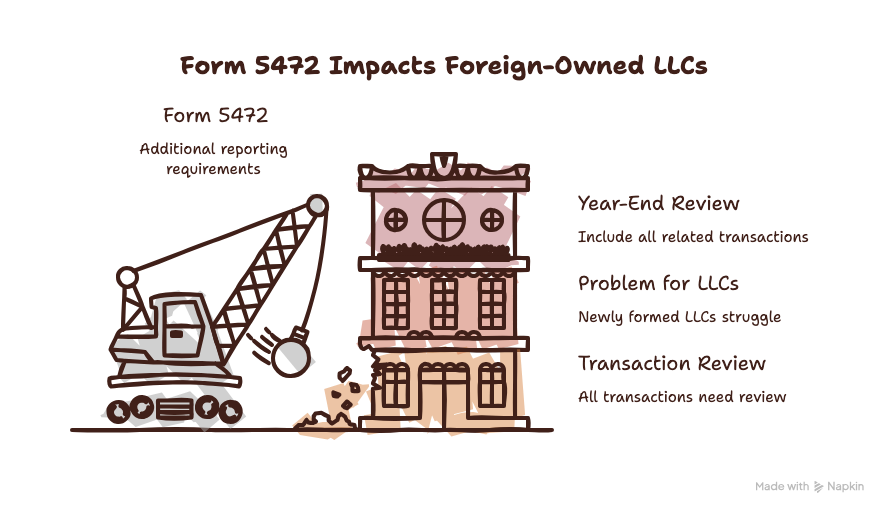
The books may have only a few transactions:
- An owner deposit
- Legal or formation fees
- A bank transfer
- An expense paid personally by the owner
- A payment back to the owner
But those transactions may still need to be reviewed for Form 5472 purposes.
A year-end review should include all transactions involving the foreign owner and related companies.
|
Transaction |
Possible Form 5472 significance |
|
Cash funded by foreign owner |
Capital contribution or loan |
|
Foreign owner pays a US vendor |
Related-party payment or contribution |
|
LLC repays owner |
Loan repayment or other related-party transaction |
|
Distribution to owner |
Distribution |
|
Foreign affiliate provides management services |
Related-party service transaction |
|
Parent supplies goods or inventory |
Related-party purchase |
|
US entity uses affiliate's software or trademark |
Royalty, license, or service transaction |
3. Treating Form 5472 Like a Regular Tax Return
Form 5472 is an information return.
Its purpose is to report certain transactions between the US reporting entity and related parties. It is not primarily a calculation of federal income tax.
Reportable transactions can include money, property, services, loans, interest, rents, royalties, purchases, sales, commissions, and other transactions. Certain noncash and less-than-full-consideration transactions can also be reportable.
This means a company can have:
- No taxable income
- No federal income tax due
- No US sales
- Very little bookkeeping activity
and still have a Form 5472 filing requirement.
Example
A foreign parent pays $8,000 of legal and accounting expenses for its US subsidiary.
The US company does not receive the cash directly.
That does not mean the transaction should be ignored.
The payment needs to be reviewed and properly reflected in the books and Form 5472 reporting, if applicable.
4. Missing the Filing Deadline
Form 5472 is generally due with the reporting corporation's federal income tax return, including extensions.
For a foreign-owned US disregarded entity, there is a special rule.
The entity generally has no regular federal income tax return filing requirement. However, if Form 5472 is required, it must file a pro forma Form 1120 with Form 5472 attached.
The deadline follows the due date of the pro forma Form 1120, including extensions.
Common problems include:
- No Form 5472 deadline is added to the compliance calendar.
- The company assumes that no income tax return means no federal filing.
- The books are not completed before the filing deadline.
- The extension is not filed on time.
- The extension is filed using the wrong procedure.
The simple solution is to identify the Form 5472 filing requirement when the US entity is formed.
Do not wait until tax preparation begins.
5. Using the Wrong Filing Method for a Foreign-Owned LLC
A foreign-owned US disregarded entity has a special filing procedure.
It cannot electronically file Form 5472.
Instead, the Form 5472 is attached to a pro forma Form 1120. The IRS requires the package to be filed by the prescribed fax or mailing procedure.
The words "Foreign-Owned U.S. DE" should be written across the top of the Form 1120.
The IRS instructions currently provide a dedicated fax number and mailing address for these filings. The filing should not be sent to the regular Form 1120 mailing address.
Common mistakes include:
- Trying to e-file the pro forma Form 1120
- Mailing Form 5472 separately
- Using the regular corporate tax return mailing address
- Failing to identify the entity as a foreign-owned US disregarded entity
- Not keeping proof that the filing was submitted
Keep the following in the permanent tax file:
- Signed Form 5472
- Pro forma Form 1120
- Form 7004, if an extension was filed
- Fax confirmation or mailing proof
- Supporting workpapers
- Copies of related-party agreements and records
6. Combining Transactions From Different Related Parties
A foreign-owned US business may have more than one related party.
The related party is not necessarily limited to the direct foreign owner.
Depending on the ownership and control structure, related parties can include:
- A direct or indirect 25% foreign shareholder
- A foreign parent company
- A foreign sister company
- Another company within the same controlled group
- Other related persons under the applicable ownership and control rules
- Certain domestic related parties
A separate Form 5472 may be required for each related party with reportable transactions.
Example
A US subsidiary:
- Buys inventory from a foreign affiliate
- Receives a loan from another related company
- Pays management fees to its foreign parent
These are three different related-party relationships.
The company should not simply combine everything under one "foreign affiliate" without reviewing the reporting requirements for each related party.
7. Filing an Incomplete Form or Keeping Poor Records
The IRS states that a substantially incomplete Form 5472 is treated as a failure to file.
The reporting corporation also has recordkeeping requirements. The records must be sufficient to support the company's federal tax reporting and related-party transactions.
A good Form 5472 compliance file should include:
- Ownership structure showing direct and indirect foreign ownership
- Information for each related party
- Intercompany agreements
- Invoices and supporting documents
- Loan agreements and repayment schedules
- Interest calculations
- Service agreements
- Management fee support
- Inventory and purchase records
- Royalty or licensing agreements
- Bank records
- General ledger detail
- Reconciliations to the financial statements
- Support for noncash transactions
- Copies of filed Form 5472
- Copies of the pro forma Form 1120
- Copies of extensions and proof of filing
Do not rely only on the financial statements.
Form 5472 compliance requires identifying the related party, determining what type of transaction occurred, reporting the correct amount, and maintaining records to support the filing.
How the $25,000 Penalty Can Apply
|
Compliance issue |
Potential consequence |
|
Form 5472 is not filed when required |
$25,000 penalty |
|
Form 5472 is not filed in the required manner |
$25,000 penalty |
|
Form 5472 is substantially incomplete |
Treated as a failure to file |
|
Required records are not maintained |
$25,000 penalty |
|
Failure continues more than 90 days after IRS notice |
Additional $25,000 for each 30-day period, or part of a period |
|
Multiple related parties are involved |
The continuing-failure penalty can apply separately for each related party |
The IRS instructions state that the $25,000 penalty applies when a reporting corporation fails to file Form 5472 when required and in the prescribed manner, or fails to maintain the required records.
Practical Year-End Review
Before filing season, a foreign-owned US business should review the following:
- Confirm the entity's federal tax classification.
- Determine whether the entity is a 25% foreign-owned US corporation or a foreign-owned US disregarded entity.
- Identify every foreign and domestic related party.
- Review owner, parent, affiliate, and intercompany accounts.
- Review bank transfers and payments made directly by owners or related companies.
- Review credit-card transactions and reimbursed expenses.
- Classify each transaction as equity, loan, service, purchase, sale, interest, rent, royalty, reimbursement, distribution, or another transaction type.
- Determine whether Form 5472 is required for each related party.
- For a foreign-owned US disregarded entity, prepare the required pro forma Form 1120.
- Use the IRS-prescribed filing procedure.
- File Form 7004 on time if an extension is needed.
- Keep the completed Form 5472, supporting workpapers, and proof of filing.
Don't Assume a Small US Entity Is Exempt
One of the biggest mistakes is assuming Form 5472 is only a concern for large multinational companies.
It is not.
A newly formed foreign-owned US LLC may have very little activity and still have a Form 5472 filing requirement.
For example, the business may have no sales and no taxable income but have transactions with its foreign owner during the year.
That is why Form 5472 should be reviewed when the US entity is formed and again before each filing deadline.
The penalty can be $25,000 for a single failure, with additional penalties possible when the failure continues after IRS notice.
If you own a foreign-owned US company or LLC, do not assume that having little or no income means there is no federal filing requirement.
IRS source: Instructions for Form 5472




Arnold CPA is a licensed
accounting firm in Houston, Texas.
providing tax, accounting,
and CFO services for small businesses.
License no. C10791
| ACCOUNTING | TAX SERVICES | BUSINESS ADVISORY |