
Blog

Is Your US Accounting Set Up as a Real US Operation?
A foreign company can own a US business without having a good US accounting system.
I see this problem when the US operation is treated as an extension of the foreign parent instead of as a separate US legal entity.
The parent may pay US expenses, move money into the US bank account, charge management fees, pay vendors on behalf of the US company, or use the parent company's accounting system to track everything.
The business may be operating normally.
But the US books can become difficult to reconcile, difficult to report, and difficult to support at tax time.
Start With the US Entity
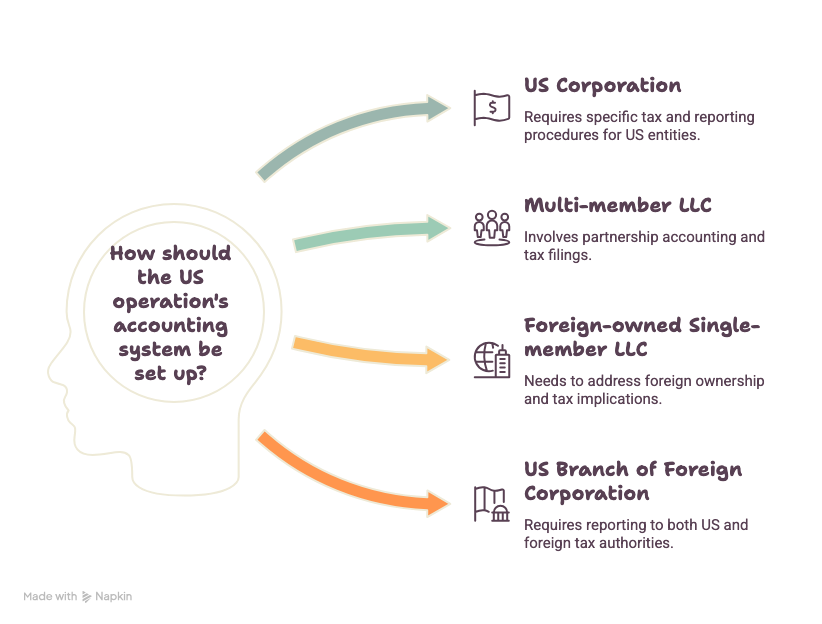
The accounting setup depends on what the US operation actually is.
It may be:
- A US corporation
- A multi-member LLC
- A foreign-owned single-member LLC
- A US branch of a foreign corporation
Each structure has different accounting and tax reporting requirements.
Before setting up the books, I want to know:
- Who owns the US operation?
- What is the US legal entity?
- How is it taxed?
- Where does it operate?
- What does it sell?
- Where are the employees?
- What transactions does it have with the foreign parent?
- What currency does it use?
- What information does the parent need each month?
Those answers determine how the accounting system should be built.
The US Books Should Stand on Their Own
The US company should have its own books, bank accounts, reconciliations, and financial statements.
That does not mean the US accounting system has to be completely separate from the parent's system.
The two systems need to connect.
The US books should support the US company's tax and financial reporting. The results can then be mapped into the parent's reporting system for consolidation.
For example, the parent may report in EUR while the US company keeps its books in USD.
The US company needs accurate USD financial statements first. The parent can then translate those results for group reporting.
Do Not Put Everything in "Due to Parent"
This is one of the areas I would look at early.
Money moving between the parent and US company can represent very different things:
- Capital contribution
- Intercompany loan
- Expense reimbursement
- Management fee
- Royalty
- Interest
- Inventory purchase
- Shared-service charge
- Distribution
These transactions should not all end up in one unexplained intercompany balance.
Each should have the appropriate account, supporting documentation, and counterparty.
Otherwise, the balance may be difficult to explain six months later.
And at tax time, someone may have to reconstruct what actually happened.
Intercompany Reconciliation Should Be Routine
The US company and foreign parent should agree on their intercompany balances.
Not just once a year.
If the US books show that the parent is owed $500,000, the parent should have a corresponding balance or appropriate group accounting entry.
Differences should be investigated when they occur.
Not during tax preparation.
The Parent's Charges Need to Be Understandable
Foreign parents often charge their US companies for:
- Management services
- Accounting or administrative services
- Technology
- Employees
- Insurance
- Intellectual property
- Financing
- Other shared costs
The question is not simply whether the parent can send an invoice.
The US company should be able to explain what the charge is for, how it was calculated, and why it belongs in the US company's books.
Depending on the transaction, there may also be transfer-pricing and withholding considerations.
Foreign Currency Needs Its Own Process
Foreign-owned businesses often have transactions in more than one currency.
For example:
The US company keeps its books in USD.
The parent operates in EUR.
The parent provides a EUR-denominated loan to the US company.
The US company cannot simply record the original USD amount and leave it there.
Foreign-currency balances may need to be remeasured, creating FX gains or losses in the US books. The US financial statements may then need to be translated into the parent's reporting currency for consolidation.
These are two different accounting steps.
They should not be mixed together.
Tax Reporting Should Start With the Accounting
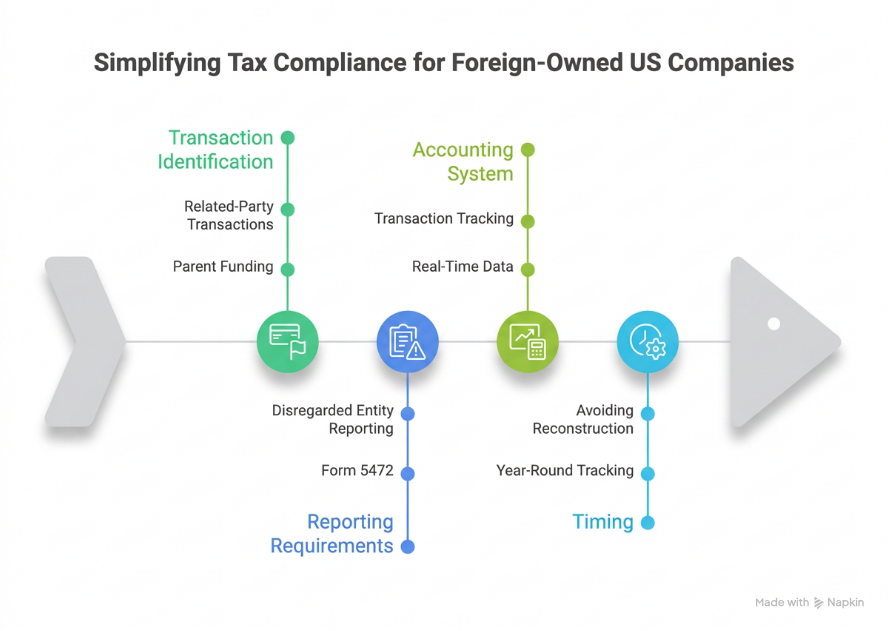
Tax compliance becomes much easier when the accounting system already identifies the transactions that matter.
For a foreign-owned US company, that may include:
- Related-party transactions
- Parent funding
- Intercompany loans
- Management fees
- Royalties
- Foreign-currency transactions
- Payments to foreign vendors
- State tax activity
- Payroll
- Sales tax
Certain foreign-owned US companies may also have Form 5472 reporting requirements.
A foreign-owned US disregarded entity can have Form 5472 requirements as well, even though it generally does not file a regular US income tax return.
The important point is that these transactions should be tracked during the year.
You should not have to reconstruct them from the bank statements when the tax return is due.
What I Would Want to See Every Month
For a foreign-owned US company, the monthly reporting package should normally give management and the parent a clear view of the US operation.
Depending on the business, that may include:
- Balance sheet
- Profit and loss
- Cash position
- Accounts receivable
- Accounts payable
- Intercompany balances
- Foreign exchange activity
- Budget versus actual
- Significant changes from the prior month
The parent should be able to understand what happened in the US without going through the entire US general ledger.
A Good US Accounting System Should Answer Basic Questions
At any point, management should be able to answer:
How much cash does the US company have?
How much does the US company owe the parent?
How much does the parent owe the US company?
What did the US company actually earn?
What costs are being charged by the parent?
What taxes are coming due?
Which transactions require additional documentation or tax reporting?
If those questions require hours of research, the accounting structure probably needs work.
Where I Usually Start
I would not start by changing software.
I would start by reviewing:
- The legal and tax structure
- The existing chart of accounts
- Bank accounts and cash activity
- Intercompany balances
- Parent-company charges
- Foreign-currency transactions
- Monthly financial reporting
- Tax and compliance requirements
- Supporting agreements and documentation
Then I would determine what needs to be fixed, what can stay, and what needs better controls.
The software is usually not the hardest part.
Getting the accounting structure right is.
If your foreign parent owns a US company and the US accounting has become difficult to manage, I can review the current setup and identify what needs to be cleaned up or changed.




Arnold CPA is a licensed
accounting firm in Houston, Texas.
providing tax, accounting,
and CFO services for small businesses.
License no. C10791
| ACCOUNTING | TAX SERVICES | BUSINESS ADVISORY |