
Blog

How a Foreign Parent Can Move Profits From a US Subsidiary
A foreign parent has several ways to move cash from a US subsidiary.
For many foreign-owned US C-corporations, a properly documented dividend is one of the simplest options. The US generally imposes a 30% withholding tax on US-source dividends paid to foreign owners. An applicable income-tax treaty may reduce that rate, often to 5% for a qualifying corporate parent, and in some cases to 0%.
But do not assume the treaty rate applies.
The result can depend on the parent's tax residence, ownership percentage, beneficial ownership, and the treaty's limitation-on-benefits (LOB) rules.
Start With the Tax Layers
For a US C-corporation subsidiary, operating profit is generally subject to US corporate income tax first.
When the subsidiary later sends after-tax cash to the foreign parent, there may be another US tax layer, such as withholding tax.
Different payment methods can produce different results.
|
Method |
US subsidiary deduction? |
Main US tax issue |
Common use |
|
Dividend |
No |
30% default withholding, potentially reduced by treaty |
Distributing residual profit |
|
Intercompany interest |
Potentially |
Withholding, §163(j), debt classification, transfer pricing |
Genuine business financing |
|
Royalty |
Potentially |
Withholding, transfer pricing, IP ownership and substance |
Genuine use of foreign-owned IP |
|
Management or service fees |
Potentially |
Transfer pricing, benefit to US company, withholding/source rules |
Actual services provided by parent |
|
Cost-sharing or IP arrangements |
Potentially |
Complex transfer-pricing and IP rules |
Genuine multinational R&D or IP operations |
|
Liquidation or return of capital |
Generally not a current deduction |
Depends on E&P, basis, treaty, and other facts |
Specific situations |
The goal should not be to eliminate US taxable income at any cost.
Intercompany payments need to reflect real business activity and arm's-length pricing. A payment that simply moves profit to the foreign parent can create transfer-pricing, withholding, and documentation problems.
1. Confirm Treaty Eligibility Before Paying a Dividend
Before using a reduced treaty withholding rate, confirm:
- The parent's country of tax residence
- The parent's direct and indirect ownership of the US subsidiary
- Whether the parent is the beneficial owner of the dividend
- Whether the parent meets the treaty's LOB requirements
- The applicable dividend article and withholding rate
- The ownership percentage required for the reduced rate
- How the parent country will tax the dividend
The US statutory withholding rate on dividends paid to foreign persons is generally 30%. A tax treaty may reduce the rate when the recipient qualifies.
Before making the payment, obtain the appropriate Form W-8BEN-E from the foreign parent.
The US company should then apply the correct withholding rate, make the required tax deposits, and complete the applicable withholding reporting, generally including Forms 1042 and 1042-S.
Do not rely on the parent's country of incorporation alone. Treaty residence and LOB qualification matter.
2. Use Dividends for Residual Earnings
For a US subsidiary with genuine US operations, a dividend is often the most straightforward way to distribute residual after-tax earnings.
The US subsidiary does not deduct a dividend.
Instead, the dividend is paid from after-tax earnings, and US withholding may apply when the shareholder is foreign.
Example
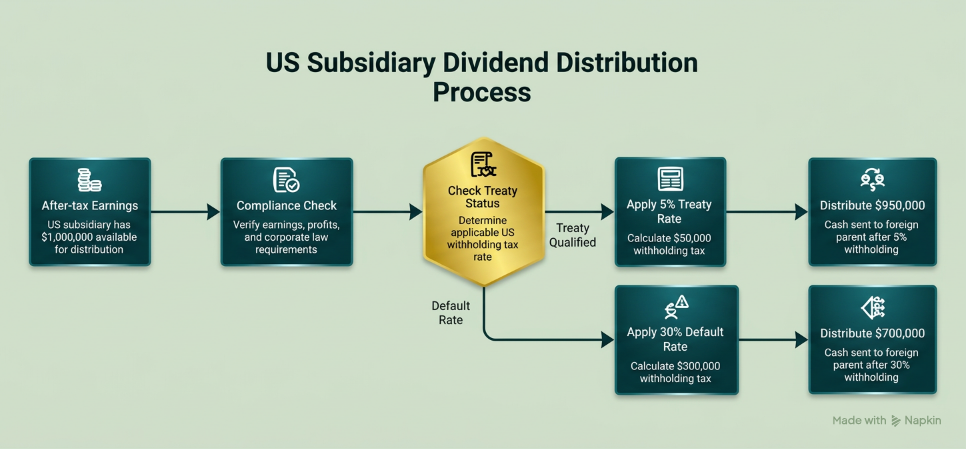
Assume a US subsidiary has $1,000,000 of after-US-tax earnings available for distribution.
If the foreign parent qualifies for a 5% treaty withholding rate:
- Dividend: $1,000,000
- US withholding: $50,000
- Cash sent to parent: $950,000
Under the default 30% withholding rate, the US withholding would be $300,000.
The actual overall tax result can be different after considering the parent's country, foreign-tax credits, exemptions, and other rules.
The dividend also needs to be supported by the company's earnings and profits and applicable corporate-law requirements.
3. Charge for Real Intercompany Services
A foreign parent may provide real services to its US subsidiary.
Examples include:
- Executive management
- Treasury and finance
- IT and shared systems
- Cybersecurity
- Human resources
- Procurement
- Legal and compliance support
- Regional marketing
- Technical support
The US subsidiary may be able to deduct payments for services it actually receives if the payments are properly supported and priced on an arm's-length basis.
Good documentation should explain:
- What services were provided
- Who provided them
- Which company benefited
- How the costs were calculated
- How the costs were allocated
- Why the pricing is reasonable
A written intercompany services agreement is also important.
Avoid vague "management fees" based simply on a percentage of revenue or profit.
If the payment does not relate to a real service that benefits the US subsidiary, the deduction can be challenged.
4. Use Royalties Only When the Parent Really Owns the IP
A foreign parent may charge the US subsidiary a royalty for the use of genuine intellectual property.
This can include:
- Patents
- Trademarks
- Software
- Technology
- Formulas
- Know-how
- Other valuable intellectual property
But the parent should actually own the IP and have the functions, people, assets, and risks that support that ownership.
The US subsidiary should also actually use the IP.
Problems can arise when:
- The US company or its employees developed the IP
- The foreign parent has little substance related to the IP
- The royalty rate is designed mainly to eliminate US taxable income
- The arrangement does not reflect the parties' actual functions and risks
Royalties paid to foreign related parties may also be subject to US withholding unless a treaty or another rule reduces or eliminates the tax.
5. Use Related-Party Debt Only When the Debt Is Real
A foreign parent can also lend money to its US subsidiary.
Interest payments may be deductible by the US subsidiary, subject to the applicable rules.
But the arrangement needs to look and operate like real debt.
Consider:
- A written loan agreement
- Principal amount
- Maturity date
- Interest rate
- Repayment terms
- Creditor rights
- Ability of the US company to repay the loan
- Actual payment history
- Arm's-length pricing
A note that is called "debt" but functions like equity can create problems.
Interest deductions may also be limited under Section 163(j) and other rules.
Interest paid to a foreign parent can also create US withholding requirements.
The point is simple:
Use related-party debt because the business has a genuine financing need, not simply to create a US tax deduction.
6. Do Not Ignore Transfer Pricing
Intercompany transactions between a US subsidiary and its foreign parent should be reviewed under the arm's-length standard.
This applies to:
- Services
- Royalties
- Loans
- Interest
- Inventory
- Management fees
- IP transfers
- Other related-party transactions
The pricing should reflect what unrelated parties would have agreed to under similar circumstances.
The company should also maintain documentation supporting the pricing and the underlying transaction.
This is especially important when the payment significantly reduces the US subsidiary's taxable income.
7. Watch the Withholding Rules
Withholding is not limited to situations where the US company physically wires cash to the foreign parent.
Certain accrued, credited, netted, or otherwise settled payments can also create withholding and reporting issues.
Before making an intercompany payment, determine:
- Is the payment US-source income?
- Is the recipient a foreign person?
- Does the payment fall under a withholding category?
- Does a tax treaty reduce the withholding rate?
- Does the recipient qualify for the treaty?
- Is the required W-8 form on file?
- Are Forms 1042 and 1042-S required?
Missing withholding can create a tax liability for the US company even when the underlying transaction itself is legitimate.
8. Remember Form 5472
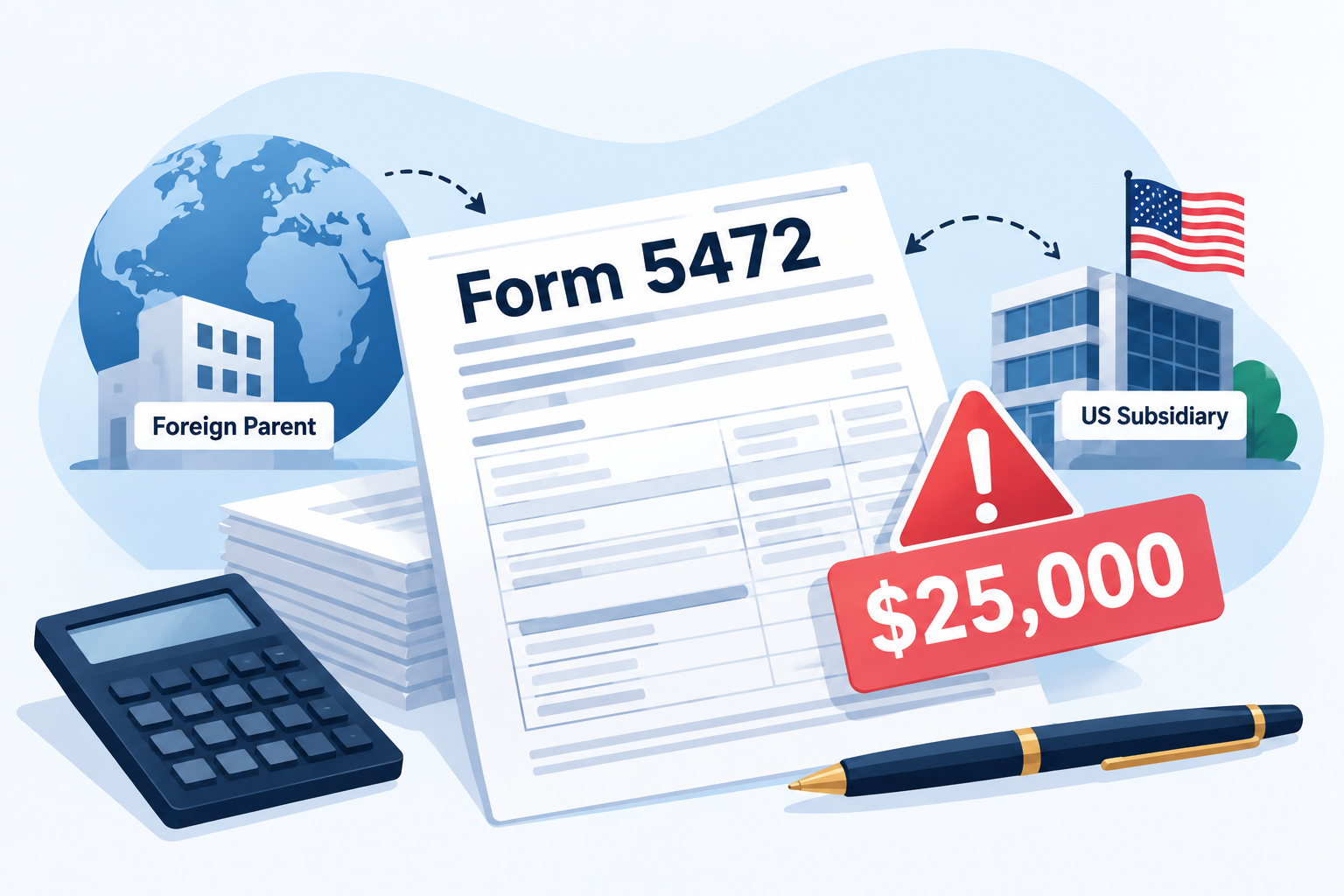
Foreign-owned US corporations can have Form 5472 reporting requirements for transactions with related parties.
These transactions can include:
- Capital contributions
- Loans
- Interest
- Services
- Purchases
- Sales
- Royalties
- Other related-party transactions
Form 5472 is an information return. It is separate from the question of whether the transaction creates taxable income.
The penalties can be significant. A failure to file Form 5472 when required can result in a $25,000 penalty, with additional penalties possible if the failure continues after IRS notice.
9. Consider the Parent Country's Tax
US tax is only part of the analysis.
The foreign parent may also have tax consequences when it receives:
- Dividends
- Interest
- Royalties
- Service fees
- Other payments from the US subsidiary
Depending on the country, the parent may have a participation exemption, foreign-tax credit, withholding-tax credit, or other relief.
That means the lowest US tax does not necessarily produce the lowest overall tax.
The analysis should look at both sides of the transaction.
10. Do Not Forget State and Global Tax Issues
The US federal tax result is not the entire picture.
Depending on the company and its ownership structure, the analysis may also need to consider:
- State income or franchise taxes
- Foreign-country taxes
- Foreign-tax credits
- Controlled foreign corporation rules
- Global minimum tax rules
- Pillar Two for groups that are within its scope
- Transfer-pricing documentation
- Corporate-law requirements
These issues can change the economics of an intercompany payment.
Common Mistakes
Assuming the treaty rate automatically applies
The parent's country is not enough. Treaty residence, beneficial ownership, ownership percentage, and LOB requirements may all matter.
Treating every parent charge as deductible
A shareholder's general oversight or investor activity is not automatically a deductible service.
Using a foreign IP company without real substance
Legal ownership of IP does not automatically establish that the foreign company should receive all of the related income.
Overleveraging the US subsidiary
A related-party loan needs to have genuine debt characteristics and commercially reasonable terms.
Ignoring withholding
A payment can create withholding obligations even when the payment is not a traditional cash transfer.
Focusing only on US tax
The foreign parent's country may tax the payment as well.
A Practical Approach
Before moving significant cash from a US subsidiary to a foreign parent:
- Map the ownership structure.
- Confirm the parent's country of tax residence.
- Review the applicable tax treaty.
- Confirm the parent's LOB and beneficial-owner status.
- Calculate the US subsidiary's taxable income and E&P.
- Determine how much cash the US business actually needs to retain.
- Review possible dividends, service fees, royalties, and debt.
- Confirm that each intercompany transaction has a real business purpose.
- Set arm's-length pricing where required.
- Put intercompany agreements in place before making the payments.
- Obtain the appropriate W-8 form.
- Calculate and remit any required withholding.
- Complete the required federal reporting.
- Review the tax treatment in the foreign parent's country.
Need Help With a Foreign-Owned US Company?
If you own a foreign company with a US subsidiary or US LLC, the tax filing is only part of the job.
The ownership structure, related-party transactions, withholding, Form 5472, transfer pricing, and foreign-parent payments all need to work together.
If you want to review your US structure and understand what needs to be filed before making payments to your foreign parent, schedule a consultation with Arnold CPA.
👉 Book a call: tdacpa.com/appointment




Arnold CPA is a licensed
accounting firm in Houston, Texas.
providing tax, accounting,
and CFO services for small businesses.
License no. C10791
| ACCOUNTING | TAX SERVICES | BUSINESS ADVISORY |